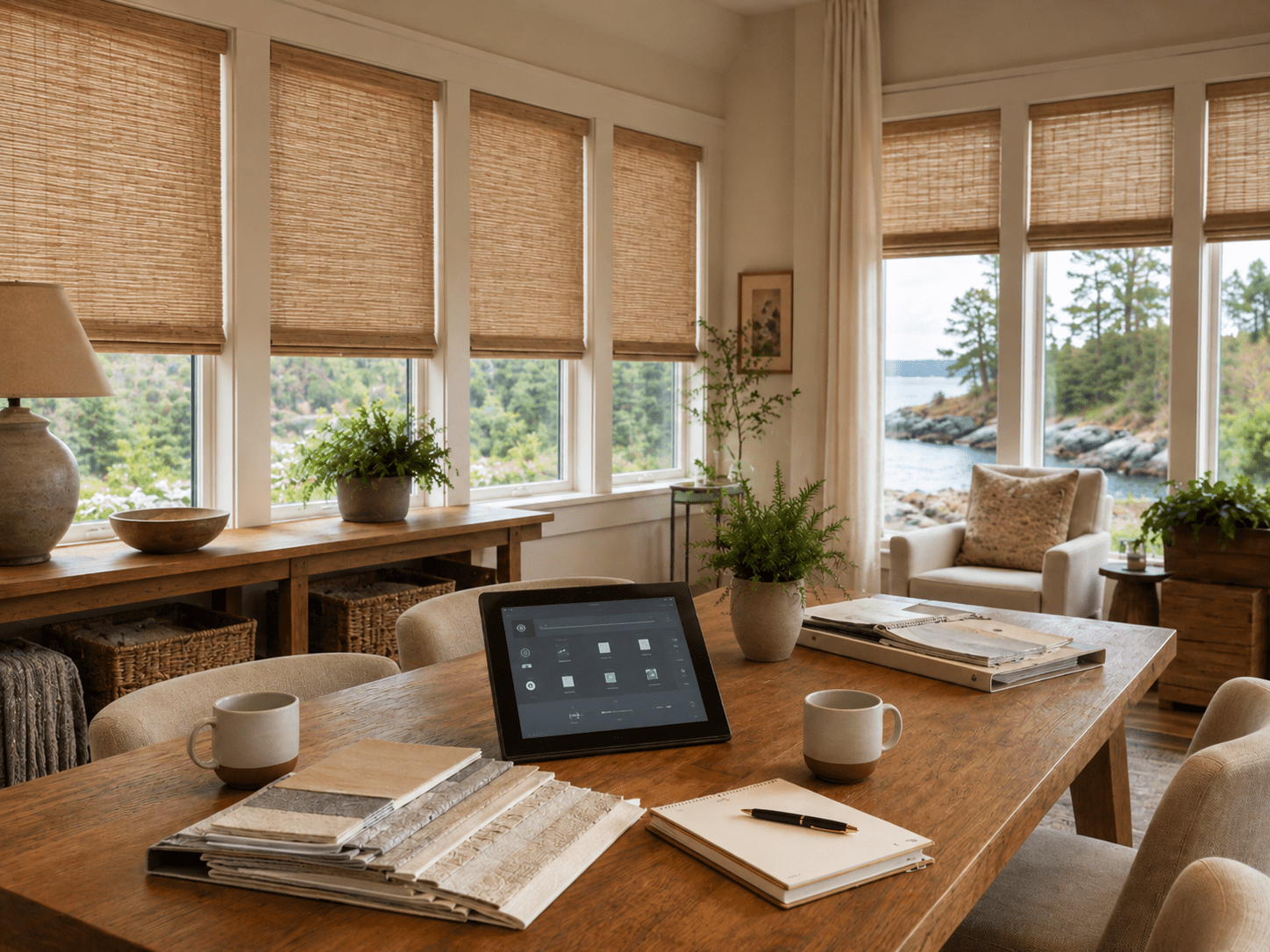
Designed, Measured & Installed — Portland, Maine

Custom Drapery in Portland, Maine

Drapes, curtains and sheers made to your measurements. Hundreds of designer fabrics to borrow and take home, and a team that specifies the fullness, pleat, lining and hardware, then installs it themselves.

Book a free consultation
Hundreds of designer fabrics Portland showroom — borrow the books 5.0 stars on Google Our own measure & install team Motorized tracks available

What “Custom” Actually Means

Choosing the fabric is the enjoyable part, and it is almost never the part that goes wrong. Custom drapery goes wrong in six decisions made before a single yard is cut. Those six are our job, not yours.

01

Fullness

How much fabric per inch of rod

Fabric width divided by rod width. Ready-made panels are usually 1.5× or less, which is why they look thin. We specify 2× as standard, and 2.5× for sheers and formal rooms. It is also the number a cheap quote quietly cuts.

02

Pleat style

How the heading is built

Pinch, French, ripplefold, grommet or a flat panel. The heading is not only a look. It decides how much wall the open panel covers, whether the drapery can run on a motorized track, and how a large pattern reads once it is gathered.

03

Lining and interlining

What is behind the face fabric

Lining protects the face fabric from the sun and gives the panel body. Blackout lining is a separate, denser layer for bedrooms. Interlining is a soft flannel layer in between, and it is the one most people have never heard of. It insulates a cold Maine window and quiets a room.

04

Stack-back and return

Where the fabric goes when it is open

Open drapery has to sit somewhere. If the rod was not run well past the glass, your new drapery covers part of the view every day. The return is the short piece that wraps back to the wall and closes the light gap at the edge. Both get measured in your room.

05

Hem, weights and break

How the panel meets the floor

A deep hem gives the panel enough weight to hang straight, and corner weights stop the leading edge kicking out. Then the length. Kissing the floor, a slight break, or a puddle. Each one behaves differently over a radiator or on a door you use every day.

06

Hardware

What it hangs on, and what that hangs on

A decorative rod you are meant to see, a concealed traverse rod, a ripplefold track or a motorized one. The heading and the weight of the panel decide which. Then the part nobody thinks about. What the brackets go into. Plaster and lath, or a header with no blocking, are normal in Portland houses.

Fullness, drawn to scale

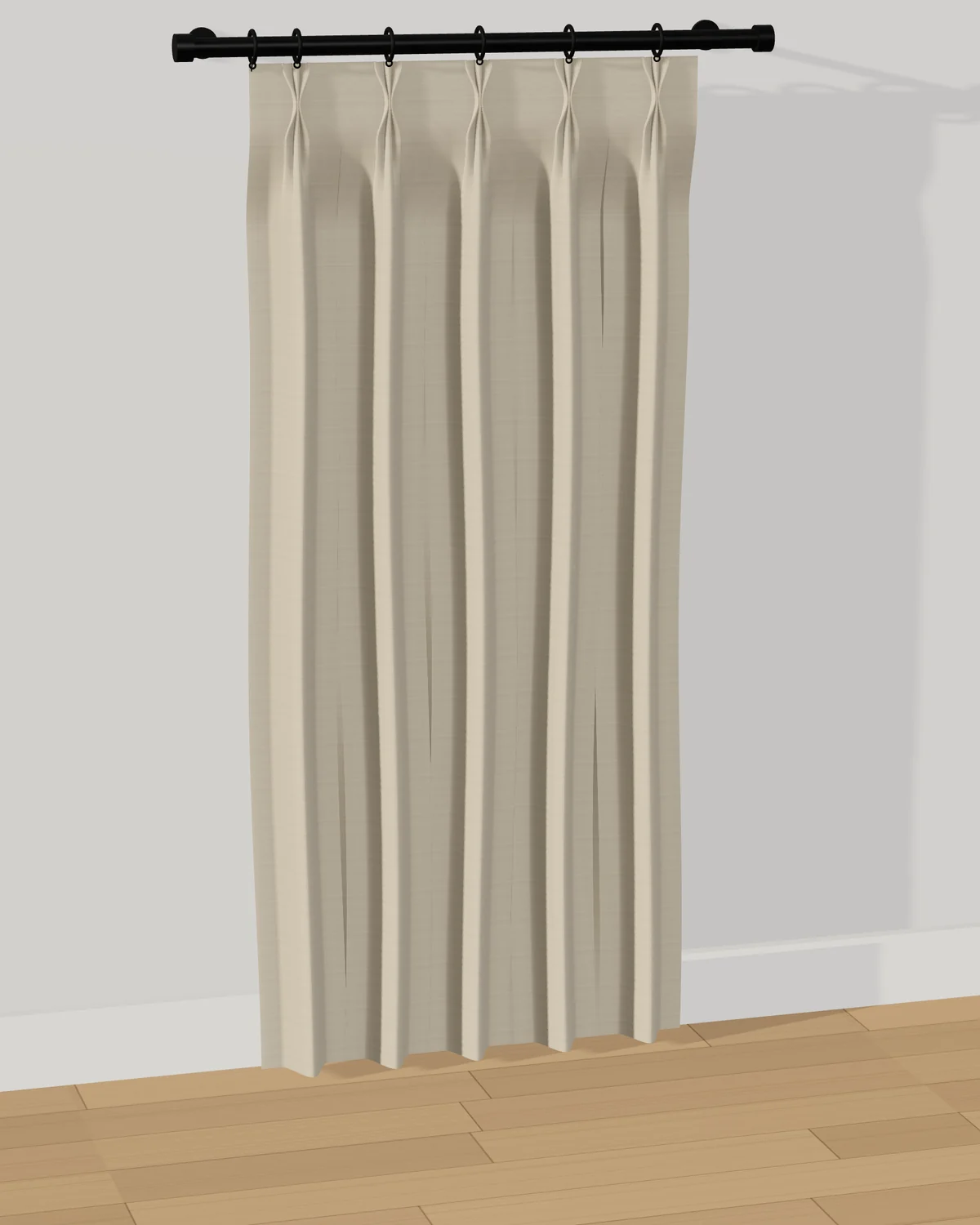
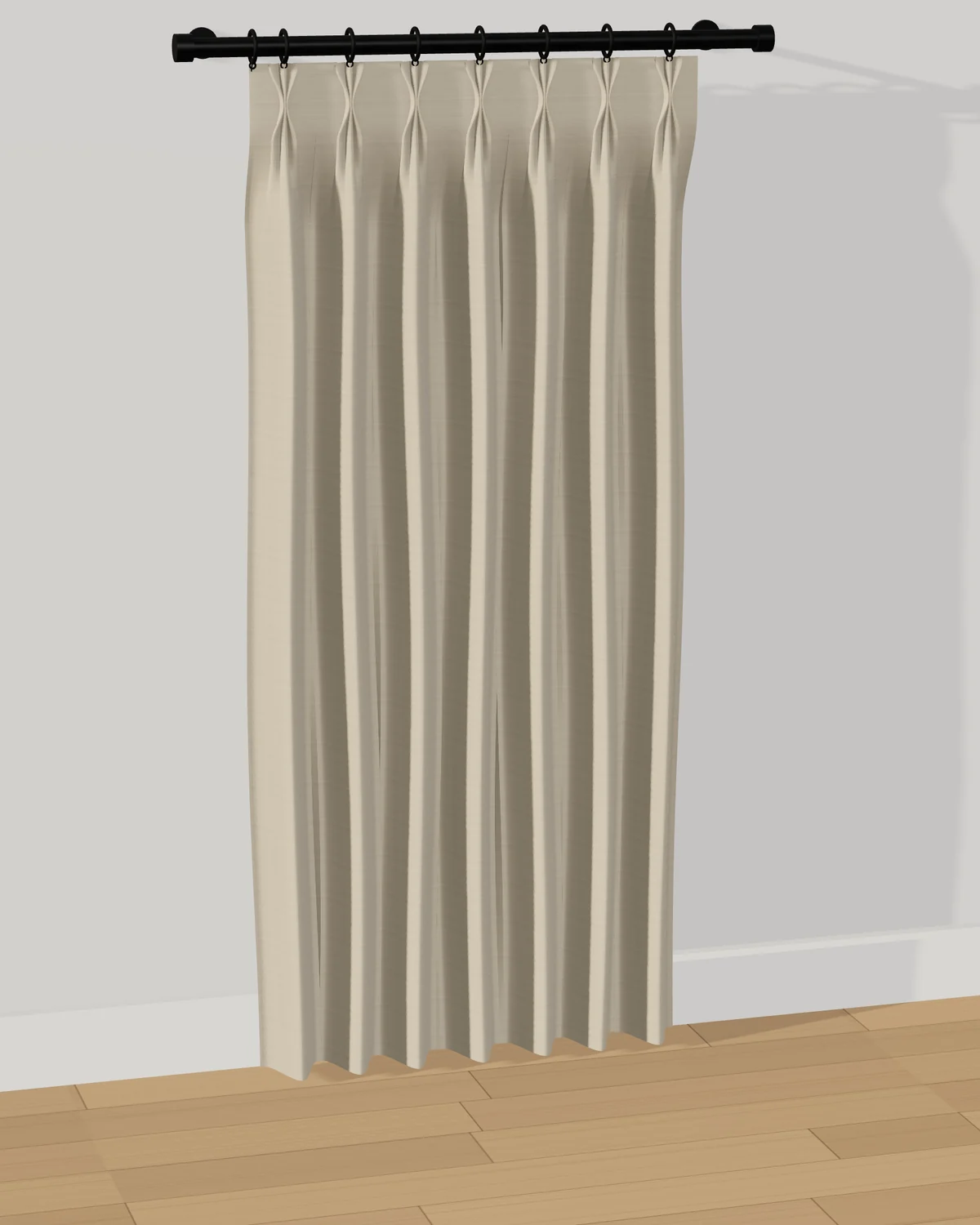
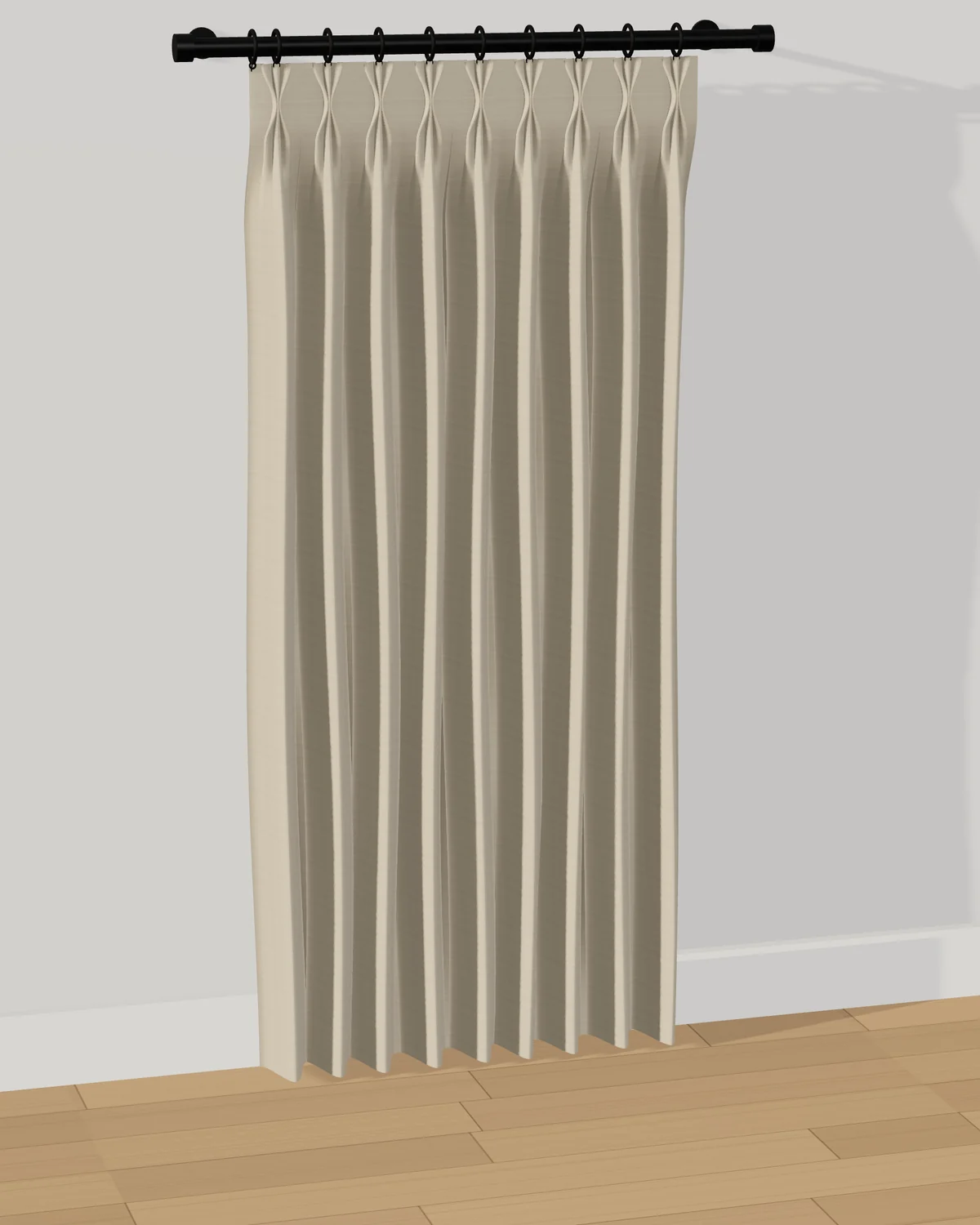
One window, one rod width, three quantities of fabric. Nothing else changes between these three drawings, which is the point. Fullness is the difference between drapery that looks generous and drapery that looks like it was bought in a packet, and it is the first thing a low quote gives away.

1.5×

Skimpy

What ready-made panels give you, and what a cheap quote quietly assumes. The panel looks flat and a little stretched when it is closed, and the folds fall out of it within a season.

Standard

The working default for most rooms and most fabrics. Enough cloth that the folds hold their shape closed and stack cleanly open. This is what we specify unless there is a reason not to.

2.5×

Full

Where sheers and lightweight fabrics belong, and where a formal room earns its money. Deeper folds, a heavier hang, and the look people mean when they say drapery rather than curtains.

The bar under each drawing is the fabric quantity, to scale. Same window, same rod, 40% more cloth from left to right.

Five headings, and what each one does

All drapery falls in folds. What changes from one style to the next is the heading, the few inches at the top where the fabric meets the rod, so that is the part drawn here. Your choice decides how much wall the open panel covers, whether it can run on a motorized track, and how formal the finished room looks.

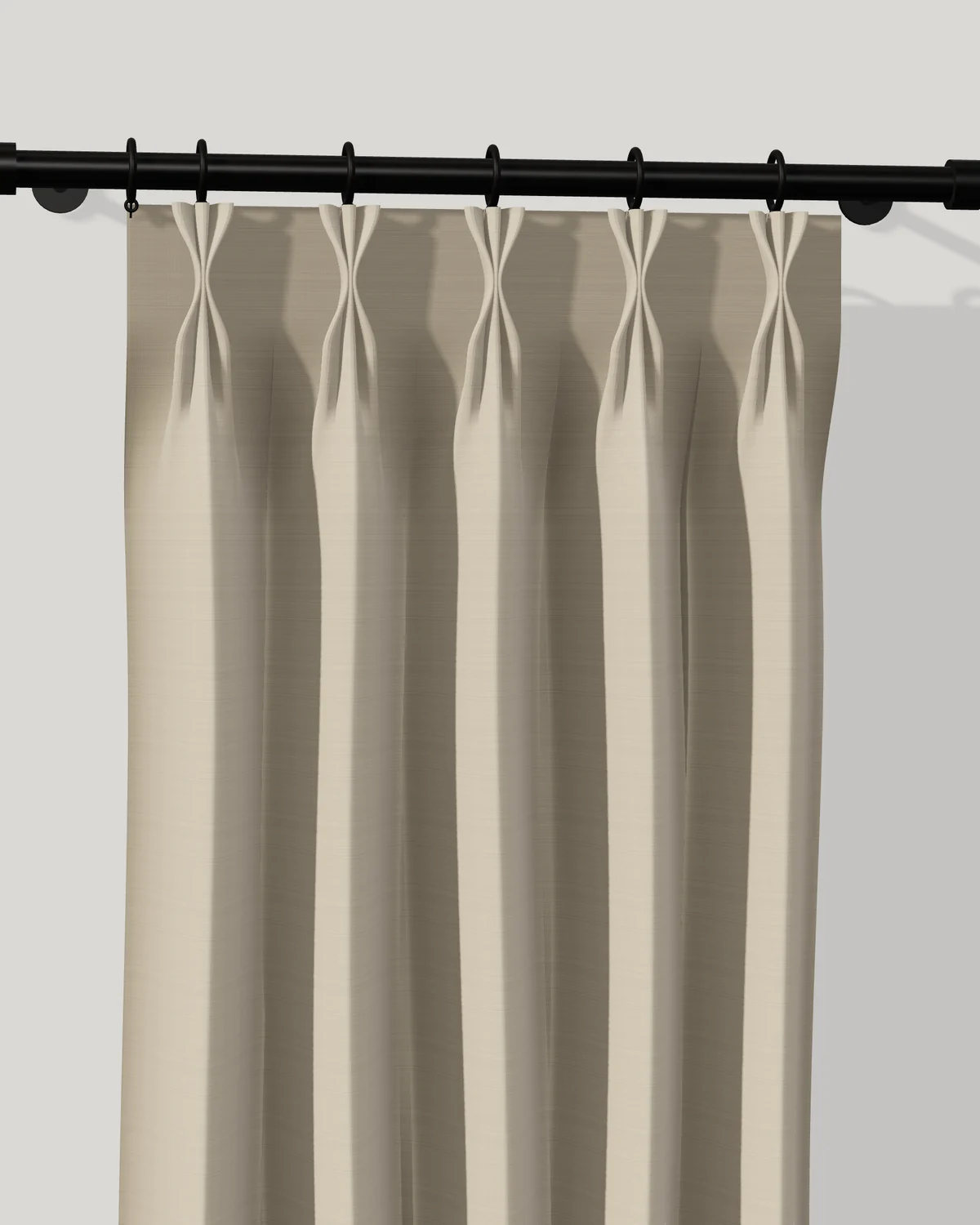
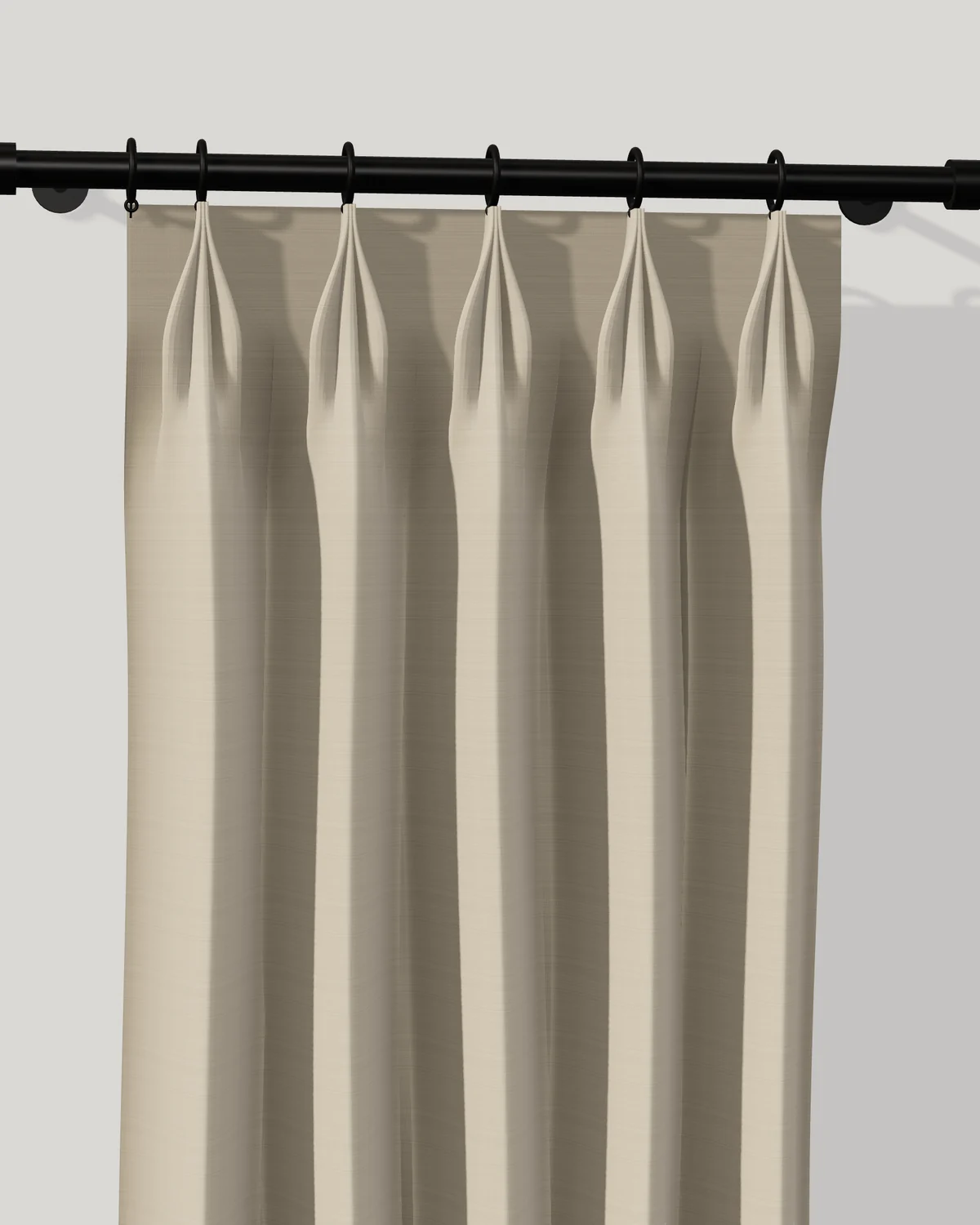
The first two look alike in a showroom and are not. The only difference is where the folds are gathered together. A French pleat gathers at the very top of the fabric. A pinch pleat gathers a couple of inches down, so the folds stay open above the gather and fan out below it. Everything else about the two drawings below is deliberately identical.

Pinch pleat

Gathered a couple of inches down

The folds stay open across the top of the header, draw together a couple of inches down, then fan out below the gather. The traditional heading, and the one that suits painted trim and older Portland houses.

2× to 2.5× fullness · pleats about 4in apart

French pleat

Gathered at the very top

The same folds gathered right at the top edge instead. Nothing sits above the gather, so the top line stays unbroken and the folds fan down from a single point. It reads cleaner and more tailored across a wall of glass.

2× to 2.5× fullness · pleats about 4in apart

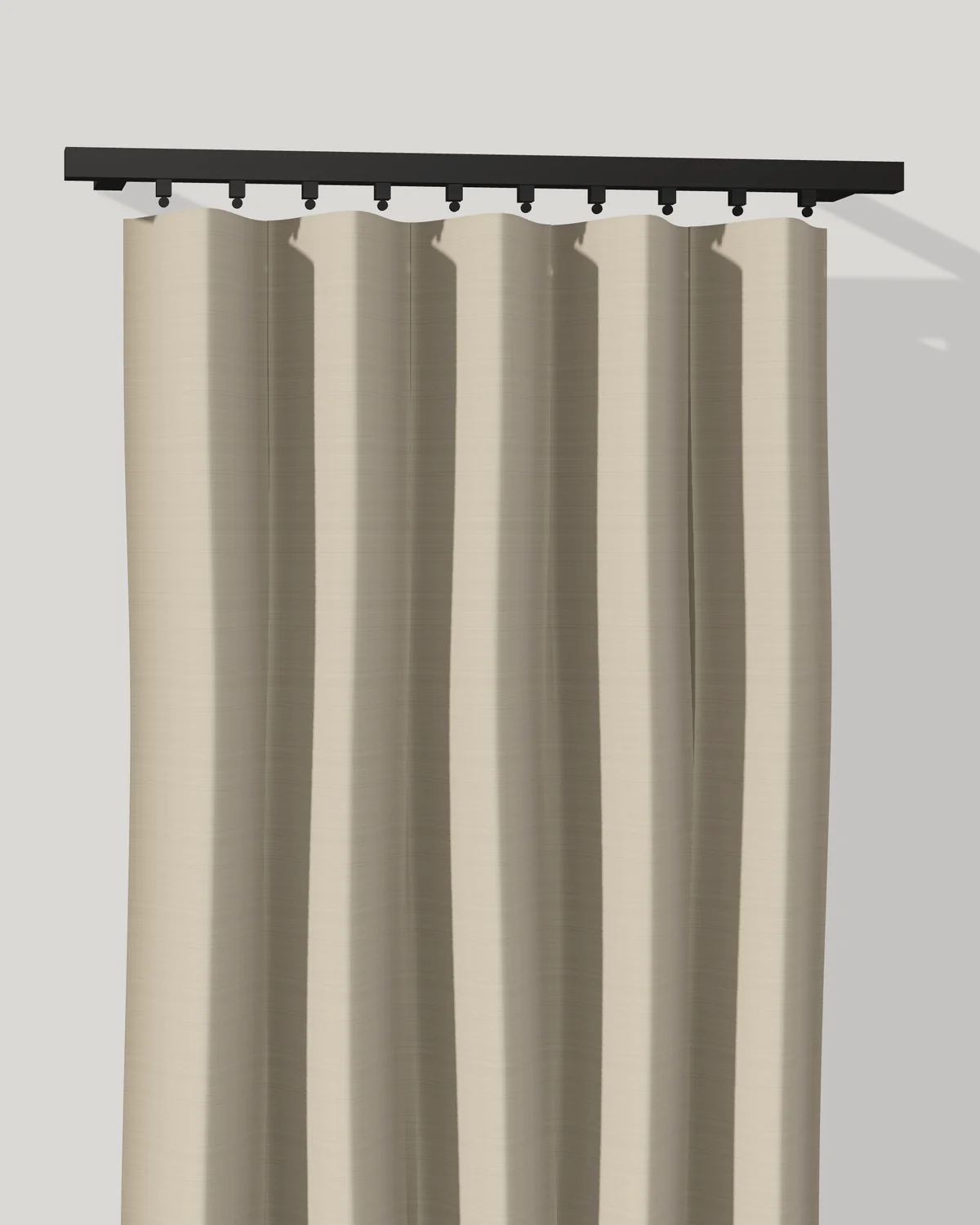
Ripplefold

Snap carriers on a track

No pleat and no stiff header. Snap carriers along a track hold the fabric in one continuous even wave, open or closed. It stacks tighter than a pleated panel and it is the natural partner for a motorized track.

Spaced by percentage, not by pleat

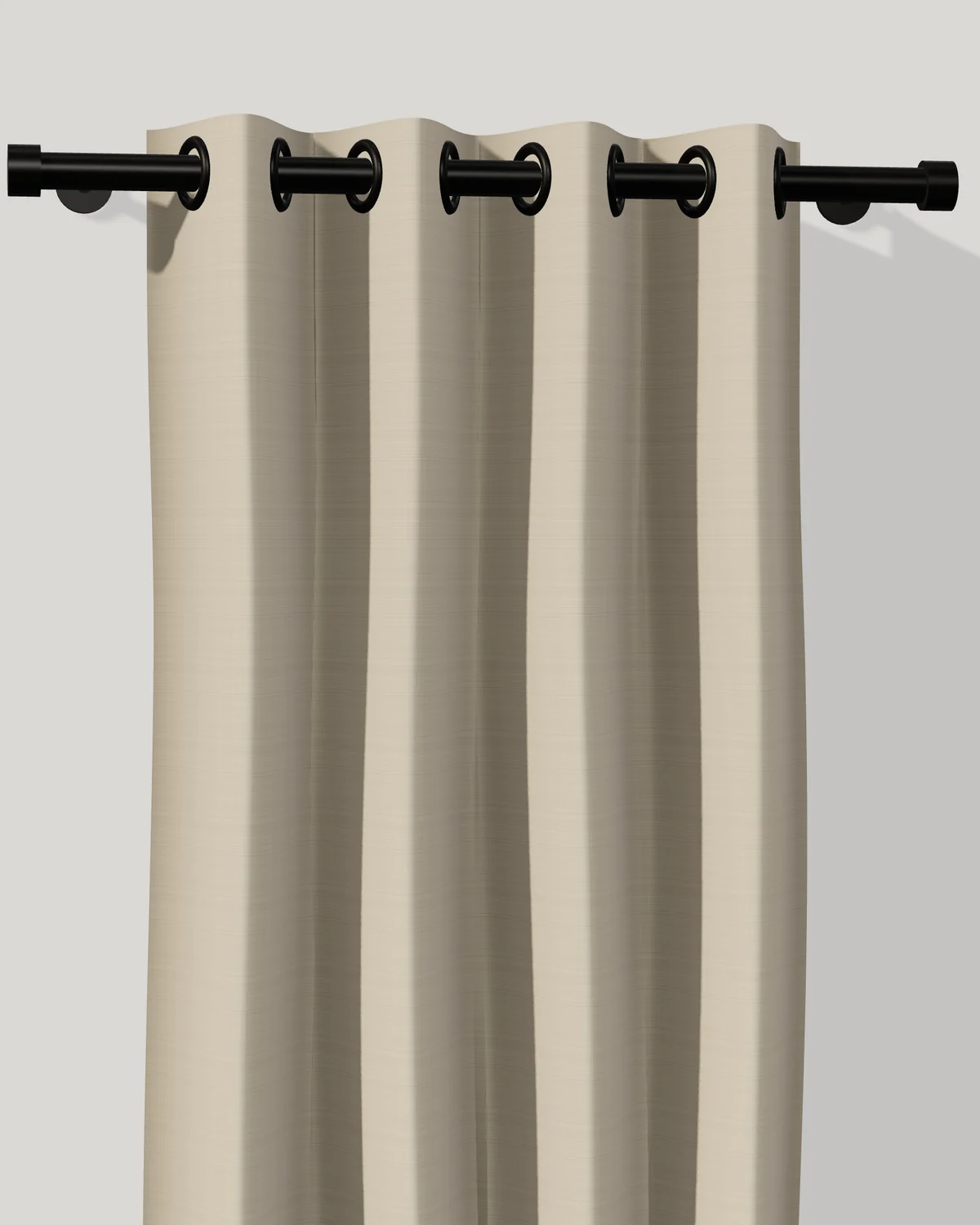
Grommet

Rod through the panel

Metal rings punched through the heading, with the rod running through them rather than behind. Casual and quick to draw by hand. The panel top sits above the rod, and it cannot be motorized.

Rings set into the header

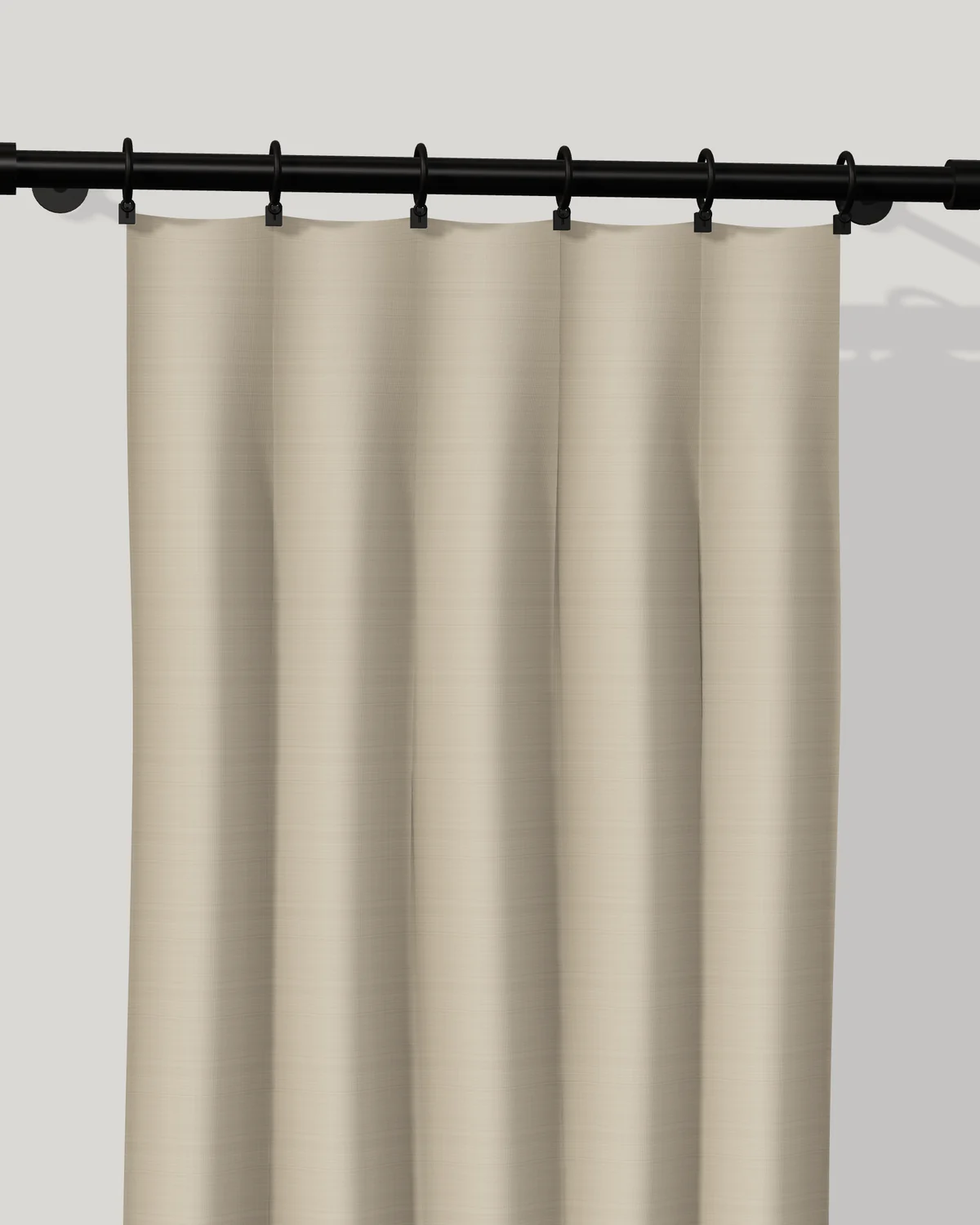
Flat panel

No pleat, hung from rings

A flat heading hung from rings, with no pleat anywhere. Quiet and architectural, and the right call when a large print or an embroidery is the whole point. Note that this is a full-length drapery panel, not a valance or a cornice. Those are short top treatments that run across the top of the window.

No pleat, no gather

Every pleated heading we specify is finished the same way. A 4in buckram header to hold the pleats crisp, pleats set about 4in apart, and a 4in double-fold bottom hem with a covered weight in each corner.

Borrow the Ones You Like. See Them in Your Light.

A fabric behaves differently in a showroom than it does on your wall, in your paint colour, under a Maine sky in February. Nobody can choose drapery fabric from a screen, and almost nobody chooses it correctly from a two-inch swatch either.

So the whole library is lendable. Hundreds of designer fabric books — Thibaut, Anna Elisabeth, Maxwell, Carole, Fabricut, Trend and more — every one of them on a cord handle because they are meant to be carried out of the door. Take home the ones you are drawn to, live with them for a few days, hold them up at four in the afternoon, and bring back the two you cannot stop looking at.

  • Hundreds of designer fabric books, free to borrow and take home
  • Drapery weights, sheers, wide-widths, embroideries, velvets, performance weaves
  • Linings and interlinings shown against your face fabric, not described
  • Trimmings, tapes and hardware finishes chosen at the same table
  • Or we bring the books to you on the in-home consultation

Motorized Drapery Tracks & Rods

A wide, lined, interlined panel is genuinely heavy to move by hand, twice a day, for twenty years. Motorized drapery is the upgrade nobody who has it gives back, and it is far cheaper specified now than retrofitted later.

Lutron drapery systems

As an authorized Lutron dealer we install the Palladiom™ drapery track — an exposed system designed to be seen, in real metal finishes — along with Serena® and concealed motorized traverse and ripplefold tracks. See the Lutron systems in action →

How you control it

A phone app, a wall keypad, a handheld remote, or your voice through Amazon Alexa, Google Assistant or Apple HomeKit. Drapery, shades and lighting can all move together in one scene rather than living on three different systems.

Schedules that follow the sun

Panels open at sunrise and close at dusk, tracking the real times as they shift through a Maine year, which between June and December is a swing of nearly six hours. Set it once. It stays correct.

Ripplefold is the natural partner

A continuous even wave on snap carriers stacks tighter and travels more smoothly along a track than a pleated heading does. If motorization is on the table, it usually decides the heading too, which is why the two are specified together.

Where it stops being a luxury

A twelve-foot slider you walk through daily. A two-storey window nobody can reach. A wall of glass where ten panels should move as one. And any panel heavy enough that, honestly, it just stays shut. More on motorization →

We program it before we leave

We set the open and closed limits so the panels land exactly where they should, build your scenes, set the schedules, connect the voice assistant you actually use, and walk you through it. A year later you call our Portland shop, not a national support line.

When Drapery Is the Right Answer

Sometimes a shade is the better product and we will say so. These are the six situations where it is not. Drapery does something here that no shade can do, or does it alongside one.

Tall and oversized windows

A two-storey window or a bank of tall double-hungs needs vertical line, and a shade gives it a horizontal one. Drapery is also the only treatment that can cover that much glass without a headrail the size of a beam.

Layering over what you already have

Side panels over existing blinds or shades finish a room without replacing anything. The shade keeps doing the light control. The drapery does the softness, the colour and the frame.

Sliders and French doors

A wide opening you walk through daily. Ripplefold on a track stacks tight and clears the door, and it can be motorized. More on the options: shades for sliding glass and patio doors.

Rooms that echo

Hard floors, high ceilings and a lot of glass make a room loud. Lined and interlined drapery is the most fabric you can put into a room in one move, and it is audible, particularly in a dining room or an open stair.

Cold glass in January

An interlined panel closed over an old window traps air the same way a honeycomb shade does, and it covers the frame and the sill as well as the glass. In a Maine house that is a comfort difference, not a decorative one.

Rooms that feel unfinished

The most common reason people call us about drapery. The furniture is right, the paint is right, and the room still reads as empty. It is almost always the windows: bare glass with nothing soft anywhere near it.

Anyone Can Sell You Fabric. Fewer Can Measure Your House.

We design the drapery, measure your windows against your trim and your floor, specify the fullness, the heading, the lining and the hardware, and commission the fabrication through drapery workrooms we have used for years, choosing the one that suits the job.

That last part is deliberate. A workroom that is superb at hand-finished interlined panels is not the one you want for a forty-foot ripplefold track. Picking per job is how the result stays right. The measuring and the installation are entirely ours, with our own team, and so is the service afterwards.

  • Free in-home consultation and measure, with the fabric books brought to your light
  • Custom-made to your measurements, never a stock size trimmed to fit
  • Line-itemed quotes, so you can see what each window costs
  • Our own installers, never a subcontracted crew
  • Panels dressed on installation day, so the folds hang right from the first hour
  • Serving Greater Portland, Coastal and Southern Maine, and Southern New Hampshire
An Accent on Windows designer showing drapery fabric samples to homeowners in the Portland, Maine showroom

Rated Five Stars by Maine Homeowners

Real Google reviews from real installations across Southern Maine.

Custom Drapery: Common Questions

Four things, roughly in order: how much fabric the window takes, which fabric you choose, the lining, and the hardware.

Fabric quantity is driven by fullness and by the size of the window, which is why a wide slider costs more than two double-hungs of the same total width. Fabric itself ranges enormously, and a large repeat in the pattern adds yardage because the pattern has to match across panels. Blackout lining and interlining each add a layer. Hardware ranges from a simple rod to a motorized track.

We quote after measuring your actual windows, and every quote is line-itemed so you can see what each window costs and where the money is going. The consultation and the measure are free.

Usually four to eight weeks from the day you approve the order, depending on the fabric and the workroom.

The clock starts with fabric: designer fabrics are cut to order and some are on back order, which is worth knowing before you fall in love with one. Fabrication follows, then we install, almost always in a single visit, including dressing the folds so the panels hang correctly from day one.

If you are working to a date — a holiday, a party, a closing — tell us at the consultation. It changes which fabrics we show you.

The fabric itself blocks essentially all the light. What you see at the edges is a different question, and it is the one that decides whether a bedroom is genuinely dark.

Light comes around drapery, not through it: down the sides, over the top and along the floor. So a dark room is a design problem, not a fabric problem. Wide panels that overlap in the middle, a rod extended well past the glass, a proper return closing the gap at the wall, and length that reaches the floor all matter more than the lining specification.

If you need a genuinely black room — a nursery, a night-shift bedroom, a media room — the honest answer is often drapery over a room-darkening shade, or a shade with side channels behind the drapery. We will tell you which one your room needs.

Yes, and it is one of the best applications for motorization there is. A wide, heavy, lined panel is genuinely hard to move by hand, and a motorized track moves it silently on a schedule or from your phone.

We install Lutron drapery systems, including the Palladiom™ track, as an authorized Lutron dealer, along with motorized traverse rods and ripplefold tracks. They run from an app, a wall keypad, a remote or a voice assistant, and they follow sunrise and sunset through a Maine year. See Lutron shades and drapery systems for how the control side works.

Two things to decide early: ripplefold is the heading that suits a motorized track best, and it is far cheaper to specify the motor now than to retrofit one later.

Yes, and it is one of the most common things we do. Side panels over an existing shade give you the softness and the colour without replacing anything that already works.

Two details matter. The mounting depth, because there has to be room for the drapery hardware to clear the existing headrail. And the rod projection, so the panels hang in front of the shade rather than against it. Both are checked on the measure.

If you are replacing the shades too, it is worth doing both at once: we can specify the shade and the drapery against each other rather than matching one to the other afterwards.

Yes. Decorative rods, finials, rings and brackets, concealed traverse rods, ripplefold track and motorized track. We specify and supply the hardware with the drapery, and install both.

It matters that they are specified together. The heading you choose decides which hardware can carry it, and the weight of a lined and interlined panel decides the bracket spacing and whether a wide span needs a centre support. Hardware bought separately from the drapery is where a lot of sagging rods come from.

Sometimes, and we will be straight with you about it. Customer’s own material is workable, but it comes with real caveats: no one can warrant a fabric they did not supply, the workroom cannot replace yardage if the pattern repeat means more is needed than you bought, and some fabrics are simply not suitable for drapery. Too light to hang, too unstable to hem straight, or prone to shrinking once lined.

Before you buy anything, bring us the fabric or a sample and we will tell you honestly whether it will make good drapery. That conversation costs nothing and it has saved a lot of people a lot of money.

In practice most people stop worrying about it once they see the library. We carry hundreds of designer fabric books, and you are welcome to borrow the ones you like and take them home.

We do the design, the measuring, the specification and the installation, and we commission the fabrication through drapery workrooms we have used for years, choosing the one that suits the job.

That is worth saying plainly, because it is a strength rather than a hedge. A workroom that is excellent at hand-finished interlined panels is not necessarily the one you want for a forty-foot ripplefold track. We pick per job, and we stand behind the result either way.

The install is entirely ours, with our own team, never subcontracted. We serve Portland, South Portland, Scarborough, Cape Elizabeth, Falmouth, Yarmouth, Brunswick, Kennebunk, York and the surrounding towns. Our showroom is at 936 Brighton Avenue in Portland.

Let’s Look at Your Windows

Call us, book a free in-home consultation, or come and borrow an armful of fabric books from our Portland showroom. Honest guidance from the local team that will design, measure, install and service your drapery.

Showroom: 936 Brighton Avenue, Portland, ME 04102

Contact Us

Tell us a little about your windows and we will get back to you soon. You will hear from someone on our own team right here in Portland. Our consultation is always free.


    Call 207.772.1088 — free consultation